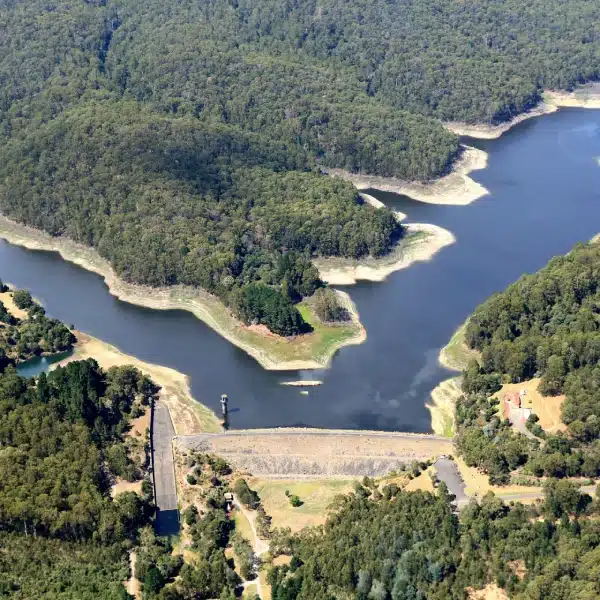
Geelong's water storages have had a wild year. In January, the region was sitting at a 16-year low. By the end of September, storages had climbed all the way back to 74.5%, comfortably ahead of where they sat this time last year.
It's a genuine turnaround, and it's worth understanding both halves of the story, because the swing itself says something useful about why your tap water sometimes tastes different depending on the season.
How low things got
Greater Geelong's water storages closed out 2025 at 47.2%. That was the lowest year end level the region had recorded since 2009, back when Geelong was in the grip of the Millennium Drought. By 20 January 2026, levels had dropped further, to 44.2%. It wasn't a one off dip either. It was the tail end of five years of steady decline.
|
Year |
Storage level (year end) |
|
2021 |
92.2% |
|
2022 |
95.4% |
|
2023 |
82.4% |
|
2024 |
55.2% |
|
2025 |
47.2% |
Barwon Water's own figures explain why. Inflows to the West Barwon Reservoir, the region's main catchment in the Otway Ranges, are down 29% since 1997. Inflows to the Moorabool system, which feeds the suburbs north of Geelong, are down 50% over the same period. And 2024 to 2025 was one of the driest two year stretches on record at three of the region's key catchments.
Then came a strong recovery
Storages didn't stay low. Winter and spring brought solid inflows, and by 30 September 2026 the region's overall storage level had climbed to 74.5%, up from just 40.4% at the same point last year. Weekly rainfall has settled to a modest 2mm, and the weekly storage change has flattened out to around -0.8%, suggesting levels have levelled off near their peak for now rather than still climbing.
That's a big shift in a short window. Storages went from a multi-year low in the mid 40s to well above their five year average in under nine months.
Why the ups and downs matter for your tap
Geelong's drinking water has always been a blend. Most of it usually comes from the West Barwon Reservoir, treated at the Wurdee Boluc plant. But when storages fall, Barwon Water leans on backup sources to keep supply secure, and pulls back on them again once storages recover.
The Anglesea Borefield is one of them. Seven bores tap a deep aquifer near Anglesea, and Barwon Water's own records show the borefield was switched on again in 2025 to 2026, specifically because of dry conditions and falling storage. It's only been activated a handful of times since it was built after the Millennium Drought.
The Melbourne to Geelong Pipeline is the other. Upgraded in 2025 to carry up to 22 billion litres a year, it can cover up to 60% of Geelong's peak demand by drawing on Melbourne's water grid when local storages are under pressure.
Each source has its own natural mineral and taste profile. So whether storages are falling and Barwon Water is leaning harder on groundwater and pipeline water, or storages are recovering and the mix is shifting back toward reservoir water, households sometimes notice a change in taste or smell during the transition. The water meets Australian Drinking Water Guidelines throughout either way. Barwon Water has said as much directly, and has flagged that shifts in supply mix can bring a change in flavour as the blend adjusts.
Don't expect the wet trend to continue
The Bureau of Meteorology's latest outlook, updated September 2026, suggests this recovery may not carry through spring. El Niño is now firmly established. For southern and central Victoria, including Geelong, there's only a 20 to 40% chance of above median rainfall between October and December. At the same time, there's an 80%+ chance of unusually high spring temperatures across the state. Warm and dry is exactly the combination that tends to draw storages back down rather than keep them topped up.
It's also why Barwon Water has been consulting the community on its 2027 Urban Water Strategy, even with storages currently sitting healthy. The region may need an extra 55 billion litres of water a year within 50 years, as population growth and a drier long term climate place more demand on a system that's already shown how quickly it can swing from comfortable to strained. Barwon Water's own modelling has flagged that without further investment, it may struggle to reliably meet demand for the system supplying more than 90% of its customers, as early as 2027.
Permanent Water Saving Rules remain in force across the region regardless of how full storages are looking right now. Worth keeping in mind for anything from watering the garden to hosing down the driveway.
What it means at home
None of this makes Geelong's tap water unsafe at any point in the cycle. Barwon Water is clear that it continues to meet the Australian Drinking Water Guidelines no matter which source is supplying your street, whether storages are at 44% or 74%. But the taste, smell and mineral makeup of your water can shift as the supply mix changes, and this year has shown just how quickly that mix can move in either direction.
A whole home water filtration system handles that variability well. It doesn't matter whether this month's water is mostly coming from the Otways, the Moorabool catchments, groundwater or the Melbourne grid. A properly sized filter evens out the taste and strips out the chlorine and sediment that tend to be more noticeable during these transitions. It's also a practical way to cut down on water waste, since Permanent Water Saving Rules remain in place regardless of how the storage numbers are trending. No more running the tap for a minute to get it tasting right, and no need to fall back on bottled water.
Geelong's water storages have gone from a 16-year low to a strong recovery in under a year. If your tap water has tasted a bit different at some point recently, that swing is very likely why.
Sources
- Barwon Water, Annual Water Outlook 2025 (PDF), barwonwater.vic.gov.au
- Barwon Water, "16-year low for water storages," reported via Geelong Independent, 22 January 2026
- Barwon Water, "Geelong region water storages" and Anglesea Borefield timeline, barwonwater.vic.gov.au/water-and-waste/water-storages/geelong-region
- Barwon Water, "Seasonal changes to water supplies," barwonwater.vic.gov.au
- Barwon Water, live storage dashboard, barwonwater.vic.gov.au/learning/storages, data updated 30 September 2026
- Victorian Government, Current Water Snapshot (updated 24 September 2026), water.vic.gov.au
- Bureau of Meteorology, seasonal climate outlook, updated 24 September 2026