What changed in June 2025
The National Health and Medical Research Council updates the Australian Drinking Water Guidelines periodically, and in June 2025 it revised the health-based guideline value for lead. The previous value, set in 1996, was 0.01 mg/L. It's now 0.005 mg/L, half of what it used to be.
The new figure is based on keeping the blood lead level attributable to drinking water under 1 microgram per decilitre in children between six months and two years old. That's a deliberately cautious target aimed at the group most vulnerable to lead exposure. It's also tighter than the World Health Organization's provisional guideline of 10 micrograms per litre, and it puts Australia ahead of the European Union, which has set the same 0.005 mg/L target but given itself until 2036 to get there.
Where the lead actually comes from
Here's the part that often gets misunderstood. In most of Australia, lead isn't coming from the water utility's own pipes. NHMRC's own fact sheet notes that typical lead concentrations in major Australian reticulated water supplies are already below 0.005 mg/L before the water reaches your property. Melbourne Water's supply is a good example of this, drawn from protected mountain catchments and treated well within guideline limits.
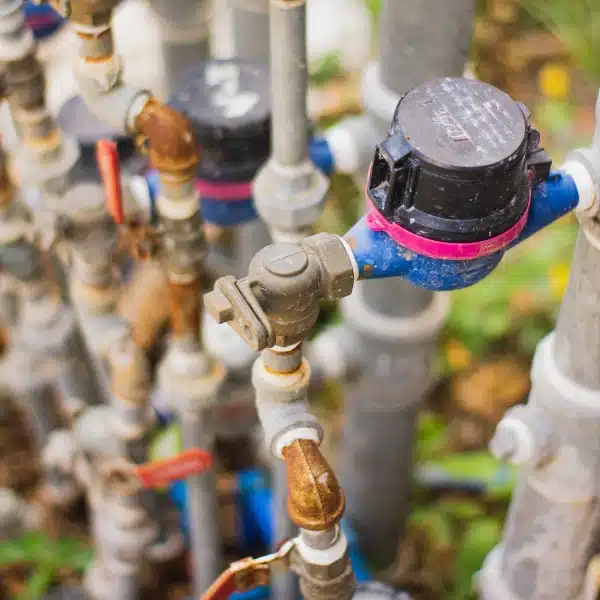
The real source, in the cases where lead does turn up, is what's inside the home. Older brass taps, valves and fittings, along with old solder joints, can leach lead into water that sits in contact with them. NHMRC's review found some Australian and international studies detecting lead as high as 0.162 mg/L at the tap, over 30 times the guideline value, entirely due to leaching from lead-containing plumbing products rather than anything wrong with the water supply itself.
This is why the regulatory story has shifted toward plumbing products rather than water treatment. Before 2021, brass fittings sold as suitable for drinking water in Australia could still legally contain up to 4.5% lead. In July 2021, the Australian Building Codes Board tightened that to 0.25%, and the Plumbing Code of Australia has continued to phase in stricter limits since. Fittings installed under the newer rules are a lot less likely to be the problem. Fittings installed decades ago, in older established homes, are the ones worth a second look.
Who this matters most for
The guideline itself is built around protecting infants and young children, since lead exposure affects developing brains more than adult ones and there's no known safe threshold for children's blood lead levels. Pregnant women are the other group most commonly flagged in the research. If you're mixing infant formula with tap water, or you live in a home built well before the 2021 fittings changes, this is worth a bit more attention than it might otherwise get.
What you can actually do about it
A few things are backed by the same research NHMRC draws on:
Run the cold tap for a short period before drinking or cooking with it, especially first thing in the morning or after the house has been empty for a while. Water that's been sitting still in contact with old fittings has had more time to pick up lead than water that's actively flowing.
Use cold water for drinking, cooking and mixing formula. Hot water leaches more lead from plumbing materials than cold water does, so it's a poor choice for anything you're going to consume even if you plan to boil it afterwards.
If your home was plumbed before 2021 and still has its original taps and fittings, a water test is the only way to know for certain what's coming out of your own tap. Guideline values and typical ranges are useful context, but they can't tell you what's happening in one specific house.
Point-of-use (RO) and whole-home filtration can help too, but only if the system is actually certified to reduce lead specifically, not every filter is. Check the certification on any system before relying on it for this, ours included.
The honest summary
Australia's water utilities are, by NHMRC's own figures, not the main source of lead in the small number of homes where it does turn up. The risk sits with older plumbing fittings inside individual properties, which is exactly why the regulatory fix has been aimed at plumbing products rather than treatment plants. If your home's fittings predate the 2021 changes, it's a reasonable thing to check rather than worry about.
Sources
- National Health and Medical Research Council, Lead fact sheet, Australian Drinking Water Guidelines, guidelines.nhmrc.gov.au
- NHMRC, Questions and answers on lead replacements in plumbing products, lead and manganese, nhmrc.gov.au
- NHMRC, Administrative and supporting information for the June 2025 ADWG updates, nhmrc.gov.au
- Australian Building Codes Board, Plumbing Code of Australia, lead content requirements (2021, 2023)
- Melbourne Water, Annual Water Quality Report